
All articles
QR Ordering Without a Till: How Salons, Barbers, Food Trucks and Coffee Carts Take Orders From a Phone
QR ordering replaces the printed menu and the order-taking step with a code the customer scans.
What QR ordering actually is
QR ordering replaces the printed menu and the order-taking step with a code the customer scans. They point their phone camera at it, a menu opens in their browser, they tap what they want, and the order arrives on a screen your staff are already watching. There's no app for the customer to download and no account for them to create — the menu is just a web page that loads on the next scroll.
The part that matters for a small business is what sits behind that. With Veno's QR ordering, the staff-facing "order screen" runs on a device you already own: a phone, a tablet or a laptop. There is no separate till, no card terminal to buy, and no engineer to book. You build your menu in the dashboard, set your prices, display the code, and open the order screen on whatever device you've got. If you have that device and an internet connection, you have a working ordering system.
That's the whole model, and it's deliberately small. It isn't a restaurant platform being sold to a coffee cart. It's an ordering layer built to run on minimal hardware, so businesses that would never buy a full point-of-sale system can still take orders cleanly.
Who it's for
This suits businesses that want to take orders for extras — usually drinks and snacks — without running a full kitchen-and-floor operation. Two broad groups:
Static businesses where the customer is seated or waiting: nail and beauty salons, barbershops.
Mobile businesses that trade from a small footprint: food trucks, coffee carts, drinks trailers, market and festival stalls.
The sections below cover each in turn. The common thread — and the reason the pricing model matters so much for this group — comes after them.
Nail and beauty salons
Salon clients are seated for a while — often forty-five minutes or more while a treatment sets. A QR code on the station or the arm of the chair lets a client add a drink or a snack without the technician stopping mid-treatment to take an order and walk to a till. The order appears on the salon's phone or tablet, someone brings it over, and it's added to the bill. (This is exactly the use case we set one salon up with recently: prosecco and coffees ordered during treatments, no terminal bought, no commission paid.) The hardware cost is zero, and the salon keeps the full drink sale minus its flat subscription.
Barbershops
Same idea, different rhythm. A barbershop's waiting bench is dead time that can be gently monetised — a coffee, a soft drink or a bottle of beer while someone waits for their chair. A QR code on the mirror or in the waiting area turns those idle minutes into small sales, and because there's no terminal to staff, the barber never breaks their flow to process one. It also reads as more considered than a fridge and an honesty box.
Food trucks
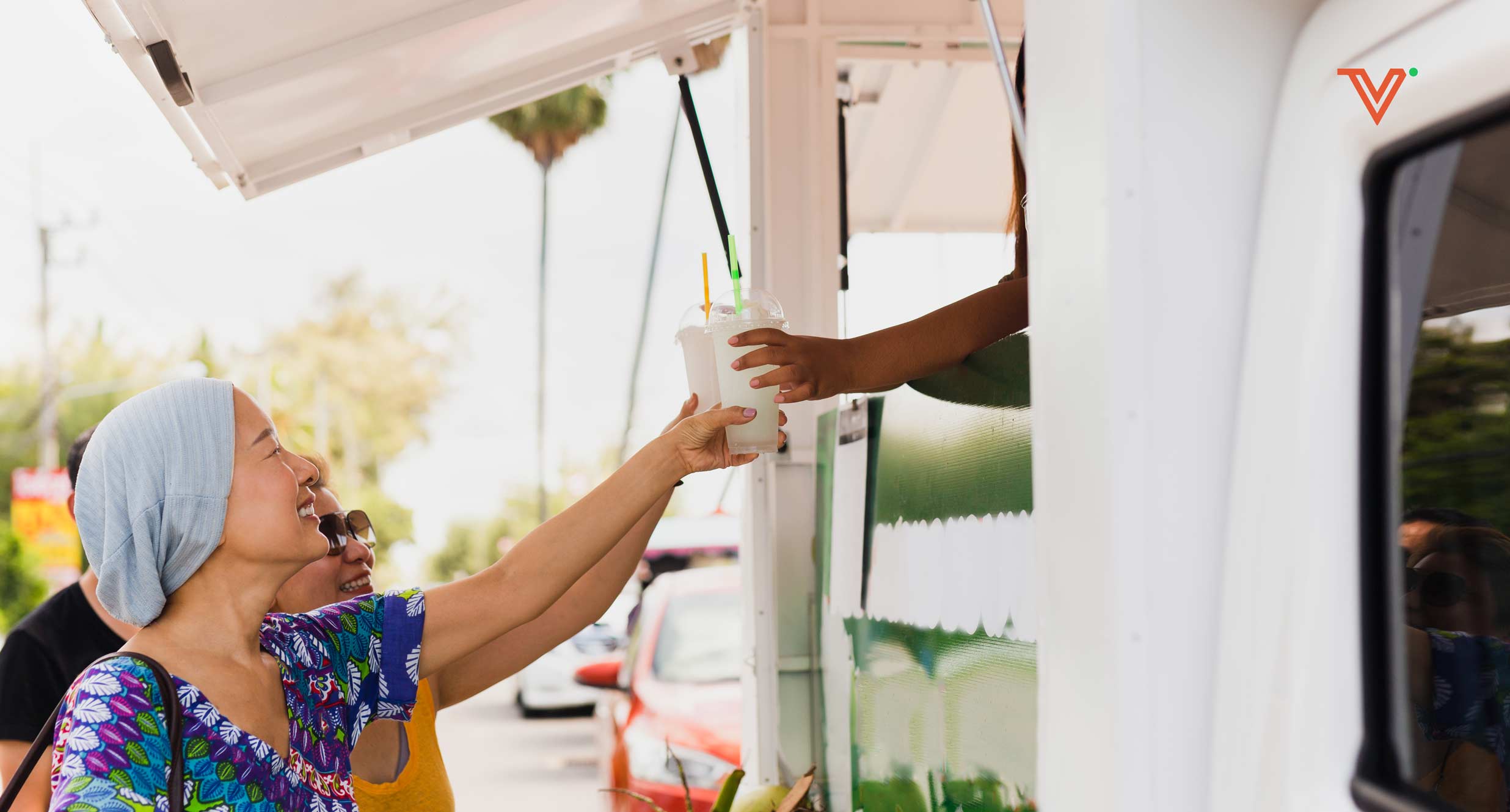
A truck's enemy is the length of its queue. Every minute a customer spends deciding at the hatch is a minute the people behind them wait, and a queue that looks too long is a sale that never happens. A QR code — on the truck, a table tent or an A-board — lets people browse and order before they reach the window, so the person at the hatch hands over food instead of reciting the menu. Modifier options handle "no onions, extra chilli" without anyone shouting across a hot griddle, and there's no bulky till to bolt down and power: the order screen is the phone in the server's apron.
Coffee carts
A cart is the most space-constrained venue there is — there's genuinely nowhere to put a traditional POS, and no appetite for one. Running the entire flow on a single phone stops being a nice-to-have here and becomes the only sensible option. A code on the front of the cart lets the morning queue order and specify — oat milk, extra shot, no sugar — while they shuffle forward, and the barista works from a running list instead of holding six orders in their head. On high volume and small tickets, a per-sale commission is a real tax on a thin margin; a flat fee doesn't grow as you get busier.
Drinks trailers and market stalls
Festival bars, mobile prosecco vans, farmers' market traders and pop-up stalls follow the same logic. They appear, trade hard for a day or a weekend, and pack down, so they can't drag fixed infrastructure around — and their high-volume, low-margin, short-window model means they feel every percentage point of commission. A QR menu that runs from a phone, needs no install for the customer and takes no cut of the till fits how they actually operate.
The thread running through all five
None of these is a full restaurant, and none wants to run a kitchen pass, a floor plan and a fleet of terminals. They want a simple way to take orders for the extras — and to keep as much of that money as possible. That second part is where the real decision gets made, so it's worth looking at the numbers directly.
How the cost compares
For a business selling a handful of drinks or snacks on the side, the feature list barely matters. What matters is what the ordering system costs to run as you get busier.
Platforms like Square typically pair their software with payment processing that takes a percentage plus a fixed fee on every transaction — for in-person card payments this commonly sits around 2.5%–2.6% plus a fixed per-sale amount, with online and manually-keyed rates higher still. (Rates change often and vary by plan and country — always check current published pricing.)
That percentage never stops. The busier you get, the more you pay — a cost of scale, not a one-off.
Many of these systems also steer you toward their own hardware, which becomes an expensive paperweight the day you switch.
The Veno model — a flat monthly fee, no cut of your sales
You pay one predictable subscription and Veno takes no commission on your sales. Sell six drinks or six hundred, the platform fee is the same.
The ordering flow runs on a device you already own, so there's no hardware to buy, mount, power or replace.
Pricing is published up front: the Orders plan is £28.99/month, with Bookings at £11.99/month and Team at £14.99/month for rota and staff tools alongside it. Current tiers are on the Veno pricing page.
With no per-sale cut, the maths gets better the busier you are — the opposite of the commission model, and exactly what a high-volume, low-margin cart or stall needs.
A commission is a variable cost that grows with your success. A flat fee is a fixed cost you can forget about. For a salon adding drinks, a truck selling burgers or a cart pouring coffee, the second is almost always the one that lets the add-on pay.
What it takes to get started
Very little. There's no terminal to install and no engineer to book. You build your menu in the dashboard, set your prices, display the QR code, and open the order screen on your phone or tablet. If you want to track what you're selling and what it's costing you, the inventory and stock tools sit alongside the ordering, so a cart owner can see margin on every cup without a spreadsheet. The core loop — scan, order, serve — is running the same day, on hardware that's already in your pocket.
The businesses in this post don't need a restaurant's worth of software. They need a clean way to take a few extra orders without buying a till, without downloading anything to the customer's phone, and without handing a slice of every sale to someone else. To see the flow in full, take a look at how QR ordering works and set your first menu live.
Keep reading
All articles →
19 July 2026
The Two-Minute Website: How Trade Businesses Are Booking Jobs and Showing Their Work Without Building a Site
Read →
19 July 2026
How Plasterers Are Swapping the Diary for a Booking Page They Actually Own
Read →
17 June 2026
Same Headline, Different Margin: Why "20% Off" Isn't One Promotion
Read →See it in your venue.
Two weeks free. No card. Up and running the same day.